


Have you ever listened to a Tidal song and wanted to save it as a regular FLAC file for offline listening? Tidal offers two FLAC audio options: Max for HiRes FLAC and High for standard FLAC. However, this feature does not mean you can download songs as FLAC files. Tidal downloads are only available inside the app and cannot be exported.
To save Tidal music as regular FLAC files, this guide explains how to convert or record Tidal songs with tools like ViWizard TIDAL Music Converter for offline listening.

Ready to take your TIDAL music offline? ViWizard TIDAL Music Converter helps TIDAL subscribers save songs, albums, playlists, artists, podcasts, and audiobooks with reliable music conversion. Start converting and keep your TIDAL library within reach.
Part 1. Can You Download TIDAL Music as FLAC Files?
TIDAL offers lossless and Hi-Res FLAC streaming, but its official downloads are not regular FLAC files. The offline feature saves songs inside the TIDAL app, where they remain protected by DRM and cannot be copied, opened, or transferred like normal audio files.
| Feature | TIDAL Offline Downloads | Standalone FLAC Files |
| Storage | Stored in the TIDAL app | Saved as regular .flac files |
| File access | Cannot be opened or moved | Can be copied, transferred, and backed up |
| Playback | Only works in the TIDAL app | Works on FLAC-compatible devices |
| Internet access | Works offline but requires the TIDAL app | Works offline without TIDAL |
| Device use | Limited to supported TIDAL devices | Works across more devices |
| Metadata | Managed by TIDAL | Can keep song info and artwork depending on the method |
| Best for | Simple offline listening | Flexible music storage |
To get standalone FLAC files, TIDAL music needs to be converted or recorded. ViWizard TIDAL Music Converter helps process and export music as FLAC, making it suitable for larger TIDAL collections. The created FLAC files are intended for personal use, such as offline listening on compatible devices.
Part 2. How to Download TIDAL Music in HiRes FLAC or FLAC
TIDAL allows offline downloads through its app and offers two FLAC quality options, including High and Max, depending on your subscription plan and the available track source. To download music, open the TIDAL app, select a song, album, or playlist, and choose the download option. TIDAL then saves the available FLAC version for offline listening.
- High: Provides lossless FLAC audio at 16-bit/44.1 kHz.
- Max: Provides high-fidelity lossless audio with Hi-Res FLAC up to 24-bit/192 kHz, depending on the original source provided by the artist or label.
01Open the TIDAL app.
02Go to Settings > Downloads > Audio.
03Select High for lossless FLAC up to 16-bit/44.1 kHz or Max for Hi-Res FLAC up to 24-bit/192 kHz when available.
04Find the song, album, or playlist you want to download.
05Open the content page and tap the Download icon to save the music.
06Go to My Collection > Downloads to find your downloaded music and play it offline in the TIDAL app.
Part 3. How to Convert TIDAL Music to FLAC with a Converter
A TIDAL music converter like ViWizard TIDAL Music Converter provides a more automated way to create local FLAC files. Instead of accessing TIDAL's protected downloads, ViWizard processes the music and converts it into a standard audio format. During conversion, the software identifies selected tracks, processes the audio data, and encodes them into FLAC while preserving available metadata such as song titles, artists, albums, and cover artwork.
To convert TIDAL music to FLAC with ViWizard, install the Windows or Mac version on your computer. The built-in browser connects to the TIDAL Web Player, allowing you to access tracks and convert them to MP3, WAV, FLAC, M4A, M4B, or AIFF. The conversion process is also designed to run at a faster speed.
Key Features of ViWizard TIDAL Music Converter
Free Trial Free Trial* Security verified. 5, 481,347 people have downloaded it.
- Convert TIDAL songs, playlists, albums, artists, podcasts, and audiobooks
- Export TIDAL music in 6 formats for different devices and players
- Preserve Hi-Res FLAC and original audio quality
- Preserve Dolby Atmos audio and metadata during conversion
- Batch download TIDAL playlists, albums, and large music collections
 Step 1: Add Tidal Songs or Playlists
Open ViWizard Tidal Music Converter on your computer and sign in to your Tidal account through the built-in Tidal player. Browse your library or search for songs, albums, or playlists you want to convert. Add the selected music to the conversion list and prepare it for processing.
 Step 2: Select FLAC as the Output Format
Open the output settings and choose FLAC as the target format. You can also adjust audio settings such as bitrate, sample rate, and channels to match your preferred sound quality. For the best results, keep the original audio settings when available.
 Step 3: Convert Tidal Music to FLAC Files
After confirming the songs and output settings, click the Convert button to start. ViWizard will process the selected Tidal tracks and save them as FLAC files on your computer. The converted files can then be accessed without opening the Tidal app.
 Step 4: Locate and Use the Converted FLAC Files
Once the conversion is complete, open the finished list or output folder to find your FLAC files. Since they are standard audio files, you can move them to supported devices such as phones, USB drives, music players, or other FLAC-compatible devices for offline listening.
[Video Tutorial]Save Tidal Tracks in FLAC Format
Part 4. How to Convert TIDAL Music to FLAC with an Audio Recorder
An audio recorder works differently because it does not convert TIDAL content directly. Instead, it captures the audio output while TIDAL is playing and saves it as a new FLAC file. Since it records system audio and encodes it into the selected format, the tool does not need access to TIDAL's internal files.
Because recording happens in real time, this method is better suited for individual tracks than large collections. Tasks such as splitting tracks, renaming files, and editing metadata may also be needed afterward. System audio recording usually produces better results than microphone recording because it avoids external noise.
01Install and launch Audacity on your computer. Select Edit > Preferences from the top menu bar. Go to the Audio Settings section and set Windows WASAPI as the Host.

02Launch TIDAL on your computer and play the tracks you want to download.
03Return to Audacity and click the red Record button immediately. Once the recording is complete, click the Stop button near the Record button.

04After the TIDAL track is recorded by Audacity, go to File > Export Audio... > Export to Computer.
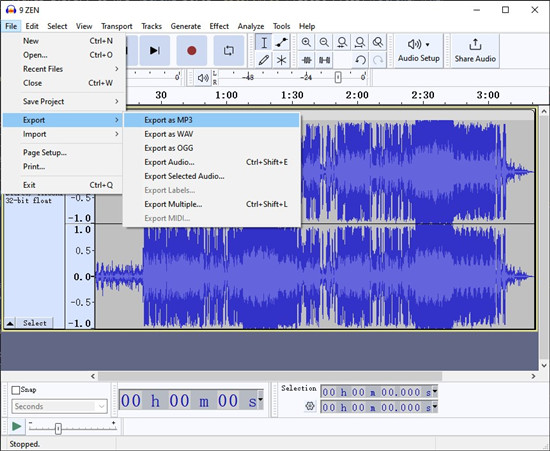
05In the pop-up window, click the Format bar to select FLAC file as the output format.

06Check other settings, and once done, click the Export button at the lower right corner.
Part 5. How to Transfer TIDAL FLAC Files to Your Devices
After conversion, TIDAL FLAC files can be transferred like other local music files. They can be stored on computers, external drives, cloud storage, smartphones, and other devices. For larger collections, organized folders, file names, and metadata help keep music easier to manage.
How to transfer TIDAL FLAC files to Android
01Download your favorite TIDAL tracks on your computer using ViWizard TIDAL Music Converter.
02Connect your Android device to your computer with a compatible USB cable.
03Locate your downloaded TIDAL FLAC files and transfer them to the internal storage of your Android device. Now, you can enjoy these FLAC TIDAL music files on your phone for offline listening.
How to transfer TIDAL FLAC files to iPhone
01Download TIDAL music as FLAC files to your computer with ViWizard or other tools.
02Connect your iPhone to your computer with a USB cable.
03Open the iTunes app on your computer and go to Files > Add File to Library/Add Folder to Library to add all the downloaded FLAC files to iTunes.

04Click on your iPhone icon within iTunes and go to Music > Sync Music > Entire music library > Apply. Once the syncing is finished, you are free to listen to FLAC TIDAL music on your iPhone.

Part 6. How to Play TIDAL FLAC Files on Your Devices
Unlike TIDAL offline downloads, converted FLAC files can be played with compatible music players or audio systems. They are not limited to the TIDAL app and can work with other lossless solutions, including digital audio players, network music servers, and home audio systems.
01First, install a music player that supports FLAC files on your device. Open the app and make sure it can play local audio files before adding your music.
02Next, add your TIDAL FLAC files to the music player. You can usually import files through an Add Files option, the Files app, or a storage scan.
03Once the FLAC files appear in your library, select a track and start playback. Unlike TIDAL offline downloads, these files can be played outside the TIDAL app with other compatible players or audio systems.
04If you use external audio equipment, connect your device to a compatible setup such as a digital audio player, network music server, or home audio system. Then select your FLAC files and start playing.
05Finally, adjust the playback settings in your music player or audio system if needed. Available high-resolution playback options depend on your device and audio hardware.
Part 7. Conclusion
| Feature | ViWizard Tidal Music Converter | Audacity |
| Support OS | Windows and Mac | Windows, Mac, and Linux |
| Support Audio Format | Lossless, MP3, M4A, M4B, WAV, AIFF, and FLAC | MP3, WAV, OGG, FLAC, and MP2 |
| Support Bitrate | Up to 24-bit | Up to 32-bit |
| Support Sample Rate | Up to 192 kHz | Up to 48 kHz |
| Batch download | Yes | No |
| Downloading Speed | 35x | 1x |
| Price | $14.95/month | Free |
Converting TIDAL music to FLAC involves understanding TIDAL's protected downloads, choosing a suitable method, and managing the converted files across devices.
A TIDAL music converter provides a simpler workflow with features such as batch conversion and metadata preservation, while an audio recorder offers a flexible option but requires more time and manual work. Once converted, FLAC files can be transferred and played on compatible devices without TIDAL app restrictions.
For an easier way to save TIDAL songs as FLAC files, ViWizard TIDAL Music Converter converts TIDAL tracks, albums, and playlists while keeping important song information. Try ViWizard TIDAL Music Converter today for free.
Can I stream all Tidal tracks in 24-bit FLAC HiRes audio quality?
No. Not every Tidal track is available in HiRes FLAC quality. It depends on the format provided by the artist or source. If a track is not available in HiRes FLAC, Tidal will stream it in standard FLAC quality instead.
What is the difference between FLAC and Tidal HiRes FLAC?
FLAC is a lossless audio format that keeps the original sound quality without losing details. Tidal HiRes FLAC refers to higher-resolution FLAC audio that goes beyond standard CD-quality FLAC, supporting up to 24-bit, 192 kHz audio. Regular FLAC usually refers to 16-bit, 44.1 kHz CD-quality audio.
How can I check the audio quality I am streaming on Tidal?
You can check it from the Tidal app settings. If you select High or Max quality, you are streaming FLAC audio. If you choose Low quality, Tidal streams music in AAC format.
On mobile devices, go to Settings > Audio & Playback. Choose When using mobile data or WiFi, then select Low, High, or Max.
On desktop, go to Settings > Streaming > Audio Quality. Then choose Low, High, or Max.
You May Be Interested


Adam Gorden, the digital media specialist at ViWizard, is dedicated to providing the best solutions for digital media management, including audio and video conversion, file optimization, and media workflow enhancements.

Leave a Comment (0)