


If you use unapproved apps to access Spotify, your account may be flagged under Spotify's security systems. Spotify enforces its Terms of Use when activity appears outside normal listening behavior, which in some cases can lead to sudden logouts, restrictions, or suspension. While Spotify does not always confirm individual enforcement actions, it reserves the right to act on policy violations, so issues may appear without clear warnings.
ViWizard Spotify Music Converter is one of these tools used for convenience, such as converting Spotify music to MP3 and processing playlists in bulk. Everything may seem normal at first, but later some users notice logouts or unstable account behavior without a clear reason.
It is not a simple yes or no situation. Spotify rarely points to a specific tool, but third-party usage patterns, like high-speed or bulk processing, may increase account scrutiny. From here, the focus is on understanding what happened, recovering access safely, and protecting your Spotify library going forward.
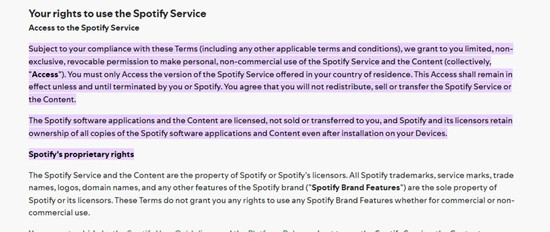
1. Violation of Spotify's Terms of Use and DRM Protection
When you use Spotify, you are accessing music under a licensed streaming model, not owning it.
At the core of Spotify's system is DRM, or Digital Rights Management. It encrypts music so it can only be played inside approved Spotify apps. Even with Premium downloads, files stay locked in the app and cannot be exported or turned into standard audio files. This reflects Spotify's licensing model, which allows streaming, not permanent file ownership.
Tools like ViWizard Spotify Music Converter convert or extract Spotify streams into formats like MP3 for offline use. While this may seem useful for backup or portability, it conflicts with Spotify's rules by moving protected content outside the official app.
Under U.S. Copyright Law (Chapter 10, Section 1008), consumers are generally protected when making digital musical recordings for non-commercial, private use. The law limits infringement actions based on this type of personal recording.
However, there is a clear difference between legal allowances and service agreements. The law may permit certain private backup uses in specific cases, but Spotify is a private service. By creating an account, users agree to its Terms of Service. If Spotify detects activity that bypasses its technical protections or usage limits, it can restrict or terminate access, regardless of separate legal protections.
ViWizard Spotify Music Converter is designed for personal and private use only, such as creating backups of your own media. Users are responsible for ensuring their use complies with applicable laws and the terms of the services they access.
2. Automated Detection and Behavioral Risk Signals
Spotify uses automated systems to monitor account behavior. These systems are not fully disclosed but generally identify unusual patterns rather than single actions.
Over time, rapid access to large numbers of tracks or continuously processing playlists in a uniform way can look different from normal listening. This becomes more relevant when third-party tools are involved.
ViWizard Spotify Music Converter can process tracks in bulk or at steady, high-speed patterns that do not match typical user activity. Some users report unexpected logouts or account suspension after heavy use, although Spotify does not confirm exact causes. These patterns can contribute to account scrutiny depending on overall usage.
3. Security and Account Access Exposure
A Spotify account is tied to playlists, history, devices, and subscription details. Using credentials in external tools can move access outside Spotify's security system and lead to issues like unstable sessions or repeated login prompts.
Spotify music converters like ViWizard Spotify Music Converter are often mentioned because some workflows may involve account-based access. In user discussions, some report logouts or verification prompts in these situations.
4. Ecosystem Mismatch and Indirect Enforcement Triggers
There is no single trigger for enforcement. Normal listening is app-based, while bulk processing or repeated extraction looks different over time and can resemble automated activity.
Spotify also distinguishes between official offline downloads, which remain encrypted in the app, and third-party tools that create external files. This difference makes outside usage more noticeable in behavior analysis.
5. Backup Strategies and Safer Alternatives
Spotify does not offer a way to export your full library as standalone files, so protecting your account comes down to strategy. If you use third-party tools, the goal is to reduce risk while keeping your main account safe.
Option 1: Use a backup account
Create a separate Spotify account for tasks like high-speed conversion or testing tools. This keeps your main account isolated, including playlists and subscription. If the backup account is flagged, your primary account remains unaffected.
Option 2: Sync your playlists safely
Set your playlists to public, then access them from the backup account by following your main profile. This lets you use the same music without exposing your primary account to higher-risk activity.
There is no perfect solution, and each method has trade-offs. A backup account adds an extra step but provides protection, while public playlists make syncing easier but may not suit users who prefer privacy.
6. Bottom Line
Using third-party tools like ViWizard Spotify Music Converter can work without immediate issues, but it carries ongoing risk. Spotify does not usually point to a specific tool, but it does respond to patterns that fall outside normal listening behavior. Over time, bulk processing, high-speed activity, or repeated access outside the official app can lead to restrictions or account issues.
If your account gets locked, recovery may be possible through official support, but outcomes are not guaranteed. For that reason, it is safer to avoid heavy or continuous usage and keep higher-risk activity separate from your main account.
How to Recover a Suspended Spotify Account (Step-by-Step Guide)There is no fully risk-free approach. The most practical option is to stay within reasonable limits while protecting your primary library.
You May Be Interested


Rick Lee is the kind of person who likes to figure out why a computer is acting up. He follows useful PC tips, learns about system settings, and looks for simple fixes to common computer problems.

Leave a Comment (0)