


Spotify makes it easy to control your music and connect to devices, including smartphones, cars, or speakers. But sometimes Spotify starts playing music on its own, even when you did not ask for it. This can happen after restarting your phone, connecting to Bluetooth, or even when the app is not open. It can be frustrating when it is hard to stop, making the feature feel less helpful and more like a bug.
The cause is not always clear, so many users end up searching through different menus to find what is triggering it, such as AutoPlay. AutoPlay automatically plays similar content, but it affects content suggestions rather than controlling automatic playback behavior.
If adjusting AutoPlay does not help, there are several effective solutions you can try to stop it entirely. You can turn off certain features, check connected devices, or adjust how Spotify runs in the background. In this guide, we will show the steps to stop Spotify from automatically playing so your music only starts when you want it to.
Part 1. Stop Spotify from Automatically Playing on Your Car, Phone, or Computer
Spotify can start playing unexpectedly for different reasons, such as features running in the background or connected devices resuming playback. Follow these steps to control these settings and manage how the app behaves on phones, computers, and other devices to stop automatic playback reliably.
Solution 1: Turn Off Autoplay in Spotify
Autoplay plays similar tracks after your playlist or album finishes. This can help you discover new music, but it often starts songs you didn't choose. Go to Settings → Playback and turn off Autoplay. You stay in control, and your listening session plays exactly as you set it.
For Desktop:
Step 1 Open the Spotify app on your computer.
Step 2 Click your profile picture in the top-right corner.
Step 3 Select Settings from the dropdown menu.
Step 4 Scroll down to the Playback section.
Step 5 Find the setting labeled Autoplay similar songs when your music ends.
Step 6 Toggle the switch off - it should turn gray when disabled.
Step 7 Close the Settings menu. Spotify will now stop playing suggested tracks automatically.
For Mobile:
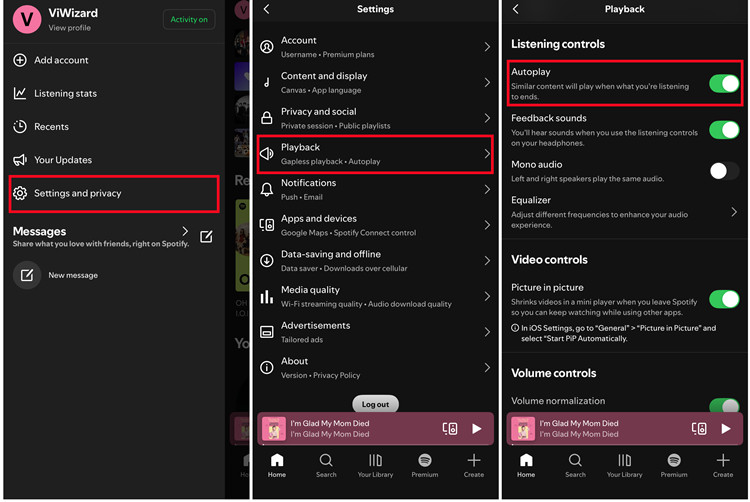
Step 1 Open the Spotify app on your phone or tablet.
Step 2 Tap the Home icon at the bottom.
Step 3 Tap the gear icon (Settings) in the top-right corner.
Step 4 Scroll down to the Playback section.
Step 5 Find Autoplay similar songs when your music ends.
Step 6 Tap the switch to turn it off - it should no longer be green or active.
Step 7 Go back to the Home screen. AutoPlay is now disabled.
Solution 2: Turn Off Smart Shuffle in Spotify
Smart Shuffle mixes tracks from outside your playlist into your queue. It can introduce new music, but it often adds unexpected songs. Turning off Smart Shuffle keeps only the songs you added, so your playlist stays predictable.
For Mobile:

Step 1 Open the Spotify app on your phone or tablet.
Step 2 Go to a playlist you've created.
Step 3 Tap the shuffle icon once - it will cycle through regular Shuffle and Smart Shuffle.
Step 4 Make sure the shuffle icon is green (not glowing) to keep Smart Shuffle off.
Step 5 You can also tap again to turn off shuffle completely if you prefer playing in order.
Step 6 Confirm that Spotify is no longer adding suggested songs to your playlist.
Solution 3: Disable the AI DJ Feature in Spotify
The AI DJ creates continuous mixes based on your listening history. Some people like it, but it can override your playlists or albums. Exiting AI DJ keeps your playlists intact and stops automatic mixes, so you stay in control.
For Mobile:

Step 1 From the Home screen, tap the Music Feed at the top.
Step 2 Select Music if not already shown.
Step 3 If AI DJ is currently playing, choose any playlist, album, or song from your library.
Step 4 Tap to start playback. The AI DJ will stop immediately.
Solution 4: Check Active Devices with Spotify Connect
Spotify Connect lets multiple devices control your account. If another phone, tablet, or speaker is connected, it can start playback without you knowing. Check your active devices and disconnect any you're not using to make sure music only plays where you want it.
For Desktop:
Step 1 Open the Spotify app on your computer.
Step 2 Click the Devices icon in the bottom-right corner.
Step 3 Review the list of active devices under Spotify Connect.
Step 4 If any devices you aren't using appear, click them and select Disconnect.
For Mobile:
Step 1 Open the Spotify app on your phone or tablet.
Step 2 Tap the Devices Available icon at the bottom of the screen.
Step 3 Review the list of connected devices.
Step 4 Make sure your own device is selected. For any device you aren't using, tap it and select Disconnect.
Solution 5: Disable Bluetooth Auto-Resume
Some Bluetooth devices, such as headphones, car stereos, or speakers, automatically send a play command when they connect. Phones pass this command to Spotify, which can start music without input. Disable Bluetooth auto-resume or adjust media settings so music only plays when you press play.
For Mobile:
Step 1 Make sure your Bluetooth device (headphones, car stereo, etc.) is connected.
Step 2 Open the Settings app on your phone.
Step 3 Tap on Sound or Sound & Vibration.
Step 4 Look for Earphone Mode or a similar setting - this may vary by device.
Step 5 Within those options, find Auto Play or similar.
Step 6 Toggle the Auto Play switch off. It should turn gray when disabled.
Step 7 Now, Spotify won't automatically start playing when you connect to Bluetooth.
Solution 6: Turn Off Car Auto-Play
Many cars resume media automatically through Android Auto or Apple CarPlay. This can cause Spotify to start even if you didn't press play. Disabling the Automatically Resume Media option in your car prevents this. Music starts only when you choose, keeping your drive free of unexpected songs.
On Android Auto:

Step 1 Open your Android device's Settings app.
Step 2 Scroll down and tap Connected Devices or Connections (depending on your device).
Step 3 Tap Android Auto.
Step 4 In the Android Auto menu, look for Automatically Resume Media.
Step 5 Toggle this setting off - the switch should turn gray.
Step 6 Spotify will no longer auto-resume when you start your car.
Solution 7: Disable Spotify Auto-Start on Windows and Mac
On computers, Spotify may launch and start playing automatically when you log in. This happens if Open Spotify automatically after you log into the computer is enabled. Changing it to No stops Spotify from starting on its own. The app opens only when you want it to, and music plays only after you start it.
On Windows:
Step 1 Open the Spotify app on your Windows computer.
Step 2 Click your profile at the top-right and select Settings. You can also click the More button (three dots) > Edit > Preferences to open the Settings menu.
Step 3 Scroll down to Startup and window behavior.
Step 4 Choose No from the drop-down next to Open Spotify automatically after you log into the computer.
On Mac:
Step 1 Open the Spotify app on your Mac.
Step 2 Click your profile at the top-right and select Settings.
Step 3 Scroll down to Startup and window behavior.
Step 4 Turn off Open Spotify automatically after you log into the computer.
Solution 8: Force Stop the Spotify App
Spotify can get stuck in the background and start playback unexpectedly. Force-stopping the app clears this state. On phones, the app cannot respond to system commands until you open it again. This often resolves sudden starts when other fixes fail, keeping playback under your control.
On Android:
Step 1 Open the Settings app on your device.
Step 2 Scroll down and tap Apps or App Management (depending on your device).
Step 3 Find and tap Spotify in the list of installed apps.
Step 4 Tap Force Stop or Stop at the bottom of the screen.
Step 5 Confirm if prompted.
Step 6 Spotify will now close completely and won't play until you open it again.
On iOS:
Step 1 Swipe up from the bottom of your screen (or double-click the home button on older iPhones) to open the app switcher.
Step 2 Locate Spotify and swipe up on the preview to close it.
Step 3 This stops the app from running in the background until you open it again.
Solution 9: Refresh Your Spotify Session
Logging out and back in or restarting the app can fix unexpected playback caused by session errors or expired tokens. If Spotify thinks a previous session is still active, it may resume music automatically. Refreshing the session resets it, ensuring the app only plays music when you want it to.
For Desktop:
Step 1 Open the Spotify app on your computer.
Step 2 Click your profile icon in the top-right corner.
Step 3 Select Log Out from the dropdown menu.
Step 4 Close the app completely.
Step 5 Reopen Spotify and log in only when you're ready to listen.
For Mobile:
Step 1 Tap the Spotify app to open it.
Step 2 Tap the gear icon (Settings) in the top-right corner.
Step 3 Scroll down and tap Log Out at the bottom of the settings menu.
Step 4 Confirm if prompted.
Step 5 Close the app. Reopen and log in again only when needed.
Solution 10: Adjust Battery Settings
Android battery optimization can stop or limit Spotify in the background. When the system kills the app and then wakes it, music may start unexpectedly. Set Battery Optimization to Restricted. This keeps the background service stable and prevents unplanned playback.
On Android:
Step 1 Open your device's Settings app.
Step 2 Scroll down and tap Battery or Battery & Performance.
Step 3 Tap Battery Optimization or App Battery Saver.
Step 4 Find Spotify in the list of apps.
Step 5 Set it to Restricted or Optimized to prevent background playback.
Step 6 Go back to Settings → Apps → Spotify → Background Activity.
Step 7 Toggle off Allow Background Activity.
Solution 11: Allow Background App Activity
iOS and Android limit background activity to save battery or system resources. If Spotify cannot run in the background, the system may restart it to finish tasks, which can trigger playback. Allow background activity so Spotify stays inactive until you open it.
For Mobile:
Step 1 Open your Android device's Settings app.
Step 2 Tap Apps or App Management.
Step 3 Find and tap Spotify from the list.
Step 4 Tap Battery or Battery Usage.
Step 5 Disable Allow Background Activity or similar.
Step 6 The switch should be gray when it's off.
Step 7 This limits Spotify to only run when opened manually.
Solution 12: Disable Handoff on iOS
Handoff allows media sessions to move between Apple devices. If enabled, another device may continue playback, causing music to start unexpectedly. Turn it off so your session stays on the device you're using.
On iOS:
Step 1 Open the Settings app on your iPhone or iPad.
Step 2 Scroll down and tap General.
Step 3 Select AirPlay & Continuity (or just Handoff, depending on your iOS version).
Step 4 Toggle the Handoff switch off - it should appear gray.
Step 5 This stops Spotify from automatically switching playback between Apple devices.
Solution 13: Turn Off Content and Privacy Restrictions on iOS
Content and Privacy Restrictions can block Spotify from accessing background services, notifications, or Bluetooth. When these restrictions interfere, Spotify may resume playback to complete interrupted tasks. Turning them off restores full access and keeps music playing only when you start it.
On iOS:

Step 1 Open the Settings app on your iPhone.
Step 2 Scroll down and tap Screen Time.
Step 3 Tap Content & Privacy Restrictions.
Step 4 Select Allowed Apps & Features.
Step 5 Find CarPlay in the list.
Step 6 Toggle CarPlay off - the switch should appear gray.
Step 7 This helps stop Spotify from starting automatically when your phone connects to your car.
Part 2. Alternative Ways to Prevent Spotify from Automatically Playing
If the previous solutions do not fully fix the problem, there are other ways to prevent Spotify from starting on its own. For example, you can create a shortcut or automation to stop Spotify as soon as it opens or connects to a car. You can also remove the Spotify app and play your favorite music offline using a USB drive, storing Spotify tracks as MP3 files for direct playback.
1. Download songs or playlists for offline use to have full control over your music
If you're having trouble playing Spotify in your car, we've got a solution for you. Let's talk about an easy way to enjoy Spotify in your car without any hassles like automatic playback.
Some folks found that the usual settings might not work as smoothly as they'd like. So, here's a simple workaround to play Spotify in your car without any issues.
You can download your Spotify music and turn it into files that can be played anywhere, like your car stereo. Using ViWizard Spotify Music Converter, you can grab all your favorite tunes from Spotify and change them into a format that any device can handle, like MP3. And guess what? You don't need a premium subscription for this – it's totally free.
Once you've converted your music, you can listen to it on any device you like – your car stereo, your phone, or your computer. For example, you can put these files on a USB drive and plug it straight into your car to start jamming out to your favorite tracks.

This post provides the 6 most popular and easiest ways for you to play Spotify music songs in your car via a cable, Bluetooth, Android Auto, CarPlay, or external drive/CD.

Key Features of ViWizard Spotify Music Converter
Free Trial Free Trial* Security verified. 5, 481,347 people have downloaded it.
- Convert Spotify songs, playlists, albums, podcasts, and audiobooks
- Export Spotify music in 6 formats for different devices and players
- Support Spotify Premium and free accounts for music conversion
- Preserve music metadata when organizing converted collections
- Batch download Spotify playlists and large music libraries
2. Set a sleep timer to automatically stop Spotify after a set time

If you enjoy listening to music before bed but don't want Spotify to keep playing all night, you can set a sleep timer. Using the Clock app on your iPhone, you can set a timer to stop Spotify (or any other media) automatically after a set time. This is great for those nights when you want the music to fade out without having to manually stop it.
For iOS:
Step 1 Open the Clock app on your iPhone or iPad.
Step 2 Tap the Timer tab at the bottom.
Step 3 Use the dial to set how long you want Spotify to play.
Step 4 Tap When Timer Ends - you'll see a list of sounds.
Step 5 Scroll all the way down and select Stop Playing.
Step 6 Tap Set to confirm.
Step 7 Now tap Start to begin the timer.
Step 8 Let your music play while the timer runs.
Step 9 When time's up, your device will stop playing Spotify (or any other media) automatically.
This is a built-in iOS feature, so it works with any music app - even if the app doesn't have its own sleep timer.
3. Create a custom Siri Shortcut to control when Spotify plays music

For even more control over your Spotify experience, you can set up a custom Siri Shortcut. This allows you to automate actions such as starting or stopping Spotify based on specific triggers, like when you connect to Bluetooth in your car or arrive at a particular location. This makes your Spotify experience more hands-free and personalized to your daily routine.
For iOS:
Step 1 Open the Shortcuts app on your iPhone.
Step 2 Tap the Automation tab at the bottom.
Step 3 Tap Create Personal Automation.
Step 4 Choose App as your automation trigger.
Step 5 Tap Next to continue.
Step 6 From the app list, select Spotify (or any app that triggers auto-play like your car or Bluetooth app).
Step 7 Tap Done after selecting the app.
Step 8 Make sure Is Opened is checked, then tap Next.
Step 9 Tap Add Action to choose what happens when the app opens.
Step 10 In the search bar, type Play and select Play/Pause under the Media section.
Step 11 Tap the word Play to change the action to Pause.
Step 12 Your automation should now read: When Spotify is opened → Pause.
Step 13 Tap Next to review the automation.
Step 14 (Optional) Toggle on Ask Before Running if you want a pop-up before it triggers.
Now, every time you open Spotify, it will either pause automatically - or ask first, depending on your settings.
You May Be Interested

10+ Ways to Stop Apple Music from Automatically Playing

Solved: How to Stops Spotify from Playing Suggested Songs

How to Fix Spotify Stops Playing Randomly [Working in 2026]

How to Stop Spotify from Opening on Startup for Windows/Mac

10+ Ways to Fix Spotify Not Showing or Not Working on Android Auto [Step-by-Step]

Why Does Spotify Play Songs Not on My Playlist?

Rick Lee is the kind of person who likes to figure out why a computer is acting up. He follows useful PC tips, learns about system settings, and looks for simple fixes to common computer problems.

Leave a Comment (0)